The 7 types of jirai-kei (and a quick quiz to find yours)
Note: sizing notes and fit reports reflect personal experience. Please confirm details on the official brand site before purchasing.
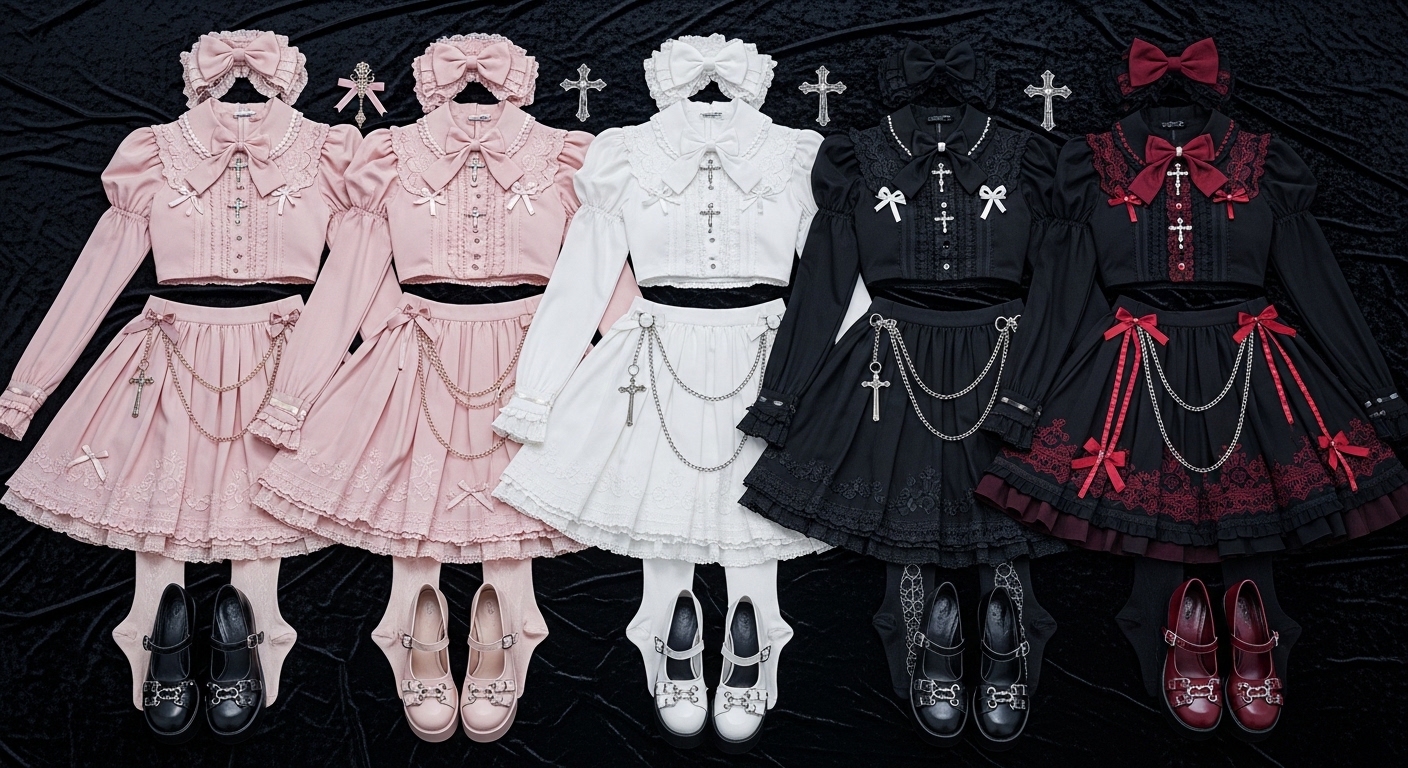
“Jirai-kei” isn’t one look — it’s an umbrella over at least seven distinct styles, from soft pink-and-white ryousangata to full black-and-red gothic. If you’re not sure which one you’re actually drawn to, the quick branching quiz at the end will narrow it down in a couple of questions.
If what jirai-kei actually is made sense but every outfit you’ve seen still looks completely different from the last one, that’s not you missing something — the style itself splits into distinct sub-styles that share a family resemblance but read very differently in person. This guide breaks down seven of them: what defines each, the colour palette and motifs, and which brands lean into it.
The 7 styles at a glance
| Style | In one line |
|---|---|
| Ryousangata | Soft pink-and-white, the gentlest entry point |
| Classic (oudou) jirai-kei | Black × pink with lace and platform boots — the image most people picture |
| Dark / gothic jirai-kei | Corsetry, velvet, Victorian detail, almost no pink |
| Yamikawa | Pastel colours next to “sick” motifs — bandages, syringes, pill capsules |
| Sweet jirai-kei | Frills and florals turned up to maximum, bordering on princess/lolita |
| Subculture jirai-kei | Fandom colours and Harajuku mixed in |
| Seiso jirai-kei | Looks demure at a glance; the jirai-kei details are subtle |
Ryousangata
The gentlest entry point. Pink-and-white, ribbon and gingham-heavy, no black required. Works for everyday wear and idol-fan meetups alike.
Ryousangata is the softest on-ramp into the wider jirai-kei aesthetic. It’s built on pink and white with heavy use of ribbons and gingham check, and — unlike most of the other styles here — it doesn’t lean on black at all. It gets dismissed as “jirai-kei but milder,” but the detail work in how ribbons and check patterns are combined is where the actual style knowledge shows.
Colours and motifs: pink and white as the base; ribbon, gingham check, pearl, heart, frill and lace as accents.
Brands to look at: DearMyLove, Ank Rouge, GRL, Ingni, Secret Honey, Avail’s majoretty line, Noemie.
Styling tips:
- Put ribbon detail on one item only — spreading it across the whole outfit reads as busy rather than intentional.
- Ground the sweetness with loafers or strap heels rather than sneakers.
- For fan-meet outfits, one accessory in your fan colour is enough — don’t rebuild the whole palette around it.
Classic jirai-kei
The image most people picture when they hear “jirai-kei”: black and pink, lace, a cross motif, platform boots. Sits right in the middle between ryousangata and the darker styles.
This is the reference image for the whole genre — black and pink together, with lace, cross motifs and platform boots doing most of the work. The balance between sweetness and darkness is the entire point, which is why accessory choices carry more weight here than in almost any other style. It sits directly between ryousangata and dark jirai-kei.
Colours and motifs: black × pink as the core pairing; dark red, platform soles, gothic lace and black ribbon as secondary elements.
Brands to look at: DearMyLove, Cielohuk, Jirapi, Noemie, With U.
Styling tips:
- Black as the base, pink as the accent — not the other way round.
- Pick a cross motif in either a necklace or earrings, not both — one is sharper than a matching set.
- Platform soles under about 8 cm stay wearable for everyday use.
Dark / gothic jirai-kei
The darkest end of the spectrum. Corsetry, velvet and Victorian detail, built almost entirely in black and red. Easiest to approach through accessories first.
This is the most fully committed version of the aesthetic. Corset-style lacing, velvet, and Victorian-era detailing define it, and it overlaps heavily with gothic lolita. Pink is largely absent — the palette is black and red, and the whole thing reads less as “an outfit” and more as a deliberate aesthetic statement. It looks intimidating from the outside, but it’s genuinely easy to start with a single accessory.
Colours and motifs: black and red as the core; burgundy, Victorian lace-up detail, and cross motifs as accents.
Brands to look at: With U, Metamorphose, Bodyline — see our full Bodyline guide if this is the style you land on.
Styling tips:
- A corset-style belt worn over an existing dress does most of the work on its own.
- Keep red to two spots — lipstick and one accessory — rather than spreading it through the outfit.
- Velvet reads as an autumn/winter fabric; in warmer months, a thin velvet choker is enough to keep the reference.
Yamikawa
Pastel colours deliberately collided with “sick” imagery — bandages, syringes, pill capsules. The gap between cute and unsettling is the whole appeal.
Yamikawa (literally “sick-cute”) pairs pastel colours with deliberately unsettling motifs: bandage wraps, syringes, pill capsules. From a distance it reads as pop and cute; look closer and there’s an edge to it. That gap is the entire appeal, and the style has strong overlap with illustrator and subculture fandoms.
Colours and motifs: pastel pink × black, or pastel purple × grey; bandages, syringes, pill capsules, eye-drop bottles, bandage strips and tear motifs.
Brands to look at: DearMyLove, Noemie.
Styling tips:
- Pastel top, black bottom is the base formula — the contrast is the point.
- One “sick” motif accessory is enough; more than that starts to read as costume rather than outfit.
- Add sneakers or a backpack to pull the whole look toward everyday-wearable.
Sweet jirai-kei
Jirai-kei’s sweetness pushed to its limit — frills, florals, pink everywhere. Sits right on the border with princess style and lolita.
This is what happens when the “sweet” side of jirai-kei is taken as far as it goes: heavy frills, floral prints, pink from top to bottom. The difference from classic jirai-kei is simple — black is almost entirely absent. It’s built on pink, white and pastel, chasing “cute” without restraint.
Colours and motifs: pink and white as the base; full frill, floral print, and ribbon. Pastel pink, lace, pearl and tiara-style accessories as accents.
Brands to look at: DearMyLove, Noemie, Ank Rouge, Axes Femme, Secret Honey.
Styling tips:
- Concentrate frill on either the top or the bottom, not both, for a cleaner line.
- Small florals read as jirai-kei; large florals start to read as a different genre entirely.
- A headpiece (headband or ribbon clip) does more for the overall silhouette than an extra layer of frill.
Subculture jirai-kei
Fandom elements — anime, oshi colours, Harajuku mixing — folded into jirai-kei. An easy, low-cost way in if you already have fan merch.
This version folds in anime, game and VTuber fandom culture: wearing your fan colour, mixing in Harajuku-style layering, working collab merchandise into the outfit. Purple and mixed colour palettes show up often, and the line between “fan culture” and “fashion” gets deliberately blurred.
Colours and motifs: purple and mixed colours; anime collabs, fan-colour accents and pin badges. Neon accents and Harajuku-style mixing and oversized silhouettes as a secondary direction.
Brands to look at: Wego, Nogenki.
Styling tips:
- Keep your fan colour to one item — a top or one accessory — so the jirai-kei base doesn’t get lost.
- A collab T-shirt under a black skirt with platform shoes reads as jirai-kei rather than plain fan merch.
- For a Harajuku mix, layering is what adds the visual density the style wants.
Seiso jirai-kei
Looks demure and put-together at first glance; the jirai-kei references are in the detail. The style you can wear to work or school without anyone clocking it.
At first glance this reads as clean, feminine and conservative — but the jirai-kei references are baked into the detail: a uniform-inspired silhouette, restrained frill, a white-and-gold palette. It’s built for people who want to try the aesthetic without going all-in, or who need something that also works in a classroom or office.
Colours and motifs: white and gold as the base; uniform-style cuts, restrained frill, brooches. Ivory, lace collars, pleats and pearl as accents.
Brands to look at: Cielohuk, Axes Femme, GRL, Ingni.
Styling tips:
- A white blouse with a pleated skirt is the reliable base formula.
- Gold jewellery adds polish without pushing the look further into costume territory.
- If you want makeup to hint at the style, tear-trough highlight and a considered lip do more than a full look.
The quick branching quiz
Start at Q1 and follow the branches — most paths resolve in two or three questions. Most people land closer to two styles than one, and that’s normal, not a sign you did the quiz wrong.
Q1. What colour matches your mood right now?
- Pink → Q2
- Black → Q3
- Purple or mixed colours → Q4
- White or ivory → Seiso jirai-kei
Q2. When you wear something sweet, do you want black mixed in?
- No, keep it pink → do you love frill? Yes: Sweet jirai-kei / No: Ryousangata
- A little black → Classic jirai-kei
Q3. In a black outfit, what detail draws you in?
- Lace or cross motifs → Classic jirai-kei
- Corsetry or velvet → Dark / gothic jirai-kei
- Bandages or “sick” motifs → Yamikawa
Q4. Do you want fandom elements in the outfit?
- Yes — I want to wear my fan colour → Subculture jirai-kei
- I like the sick-but-cute gap more → Yamikawa
- Not fandom-specific — I just want more black and pink → Classic jirai-kei
This quiz is a starting point, not a verdict — most people end up drawing from two or three of these styles depending on the day, and that’s the normal way to wear jirai-kei, not a failure to commit.
In short
Jirai-kei isn’t a single look — it’s seven overlapping styles that share a family resemblance but read very differently in practice, from the gentle pink-and-white of ryousangata to the black-and-red intensity of dark jirai-kei. Start with whichever description made you want to go look up the brands immediately; that reaction is a better guide than any quiz. Ryousangata or classic jirai-kei are the easiest starting points if you’re picking a first style to try.
Sources / further reading
- Editorial classification by the Yumekawa Plus team, based on observed brand catalogues and community usage of these style names.
- What is jirai-kei fashion? — background on the genre this guide builds on.
スポンサーリンク
Tags
スポンサーリンク